We've moved! Please subscribe to the Google Ad Manager blog for updates


Posted:
Since the acquisition of DoubleClick over 10 years ago, we’ve continuously evolved our platforms to help our partners grow their revenue and create sustainable businesses with advertising. That’s why, for the last three years, we’ve been doing more to bring DoubleClick Ad Exchange (AdX) and DoubleClick for Publishers (DFP) together into a truly unified platform. Today’s DoubleClick has also evolved beyond our roots in the web to become an ad platform for the next generation of content, from mobile applications by developers like King, to multi-platform video from publishers like Cheddar.

With these changes, we needed a new name that better reflects how our platform helps you earn more and protects your brand, wherever your audience is engaging and however advertisers are looking to work with you. As we announced today, that name is Google Ad Manager.



Over the next few months, you’ll start seeing the Ad Manager name reflected across your existing DoubleClick UI. Read on to learn more about our journey and vision.

Not just an ad server or Sell-Side Platform (SSP)—a complete ad platform

Automation continues to change the way we do business, with advertisers looking to transact all their campaigns, guaranteed or not, programmatically. That’s why we broke away from the traditional constraints of “ad servers” and “SSPs” to build new programmatic solutions directly into the product we now call Ad Manager—from our programmatic deals framework to features like Optimized Competition that help you maximize yield across reservations, private marketplaces, and the open auction. Ultimately, with Ad Manager, you get a complete ad platform that helps you earn more and grow revenue, no matter how you sell.

Optimizing revenue across all buyers

When we launched Ad Exchange nearly a decade ago, we created a marketplace to help you earn more from real-time competition for your inventory. Today’s exchange is not just an auction, but also a complete sales channel. With Ad Manager, you can curate who has access to your inventory, alongside all your reservation and programmatic demand, and optimize your relationships for yield.

So, with the integration of AdX into Ad Manager, we're retiring the Ad Exchange brand. The programmatic buyers and networks formerly called “AdX buyers” will now be known as “Authorized Buyers,” a name that reflects the close relationship you have with these partners. You’ll start seeing this change in the Ad Manager UI over the next several months.

Monetizing the new places where people are watching, playing or engaging

People now spend more time on their phones than anywhere else, and are watching more video—live or on demand—on a variety of large and small screens. This shift has created new opportunities for monetization, along with more challenges for managing ads across different screens, SDKs, and content distribution platforms.

Ad Manager gives you a single platform for delivering, measuring and optimizing ads wherever your audience is engaging—including connected TVs, Accelerated Mobile Pages (AMP), mobile games and other apps, and platforms like YouTube and Apple News.

With Advanced TV solutions like Dynamic Ad Insertion for live and on -demand video, formats like native and six-second bumper ads, and yield optimization solutions like rewarded mediation and Exchange Bidding for mobile apps, we’ve evolved Ad Manager to keep up with your customers and support your new distribution channels.

Protecting you from bad actors

Over the last year, the digital advertising industry has faced a lot of challenges, from brand safety to ad fraud. These issues can degrade user experience with inappropriate ads and annoying creatives—or, even worse, harm users with malware-laden ads, and hurt advertisers with invalid, domain-spoofed inventory and non-human bot traffic.

With Ad Manager, you can be confident the ads we deliver will respect your brand and keep your users and advertisers safe. We have more than 30 controls to help you manage the type of ads you allow to make sure they meet your brand values. In 2017, our industry-leading spam detection and policy enforcement tools took down more than 3.2 billion ads before they reached users. To ensure you don’t lose money to domain spoofing, Google was the first to integrate the IAB TechLab’s ads.txt standard into all our ads platforms. Rest assured, you have a partner invested in protecting your brand and business as the industry continues to evolve.

A solid foundation for innovation

“Google's complete and integrated ad platform has helped accelerate revenue growth while freeing our team to focus on important relationships with our advertising partners and users”
Chris Janz, Managing Director of Fairfax, Australian Metro Publishing

We’re committed to making sure that Ad Manager supports your advertising business both today and in the future. While we may be bidding a fond farewell to the DoubleClick name, we are excited for the next chapter in our journey with you—one that’s focused on sustainable growth in an industry where the only constant is change.

Posted by Jonathan Bellack
Director of Product Management

Posted:
We launched AdWords nearly 18 years ago with a simple goal—to make it easier for people to connect online with businesses. A search for eco-friendly stationery, quilting supplies, or for a service like a treehouse builder gave us an opportunity to deliver valuable ads that were useful and relevant in the moment. That idea was the start of our first advertising product, and led to the ads business we have today.

A lot has changed since then. Mobile is now a huge part of our everyday lives. People quickly switch from searching for products, to watching videos, browsing content, playing games and more. As a result, marketers have more opportunities to reach consumers across channels, screens and formats. The opportunity has never been more exciting, but it’s also never been more complex. Over the years, Google ads have evolved from helping marketers connect with people on Google Search, to helping them connect at every step of the consumer journey through text, video, display and more.

That’s why today we are introducing simpler brands and solutions for our advertising products: Google Ads, Google Marketing Platform, and Google Ad Manager. These new brands will help advertisers and publishers of all sizes choose the right solutions for their businesses, making it even easier for them to deliver valuable, trustworthy ads and the right experiences for consumers across devices and channels. As part of this change, we are releasing new solutions that help advertisers get started with Google Ads and drive greater collaboration across teams.

Google AdWords is becoming Google Ads

The new Google Ads brand represents the full range of advertising capabilities we offer today—on Google.com and across our other properties, partner sites and apps—to help marketers connect with the billions of people finding answers on Search, watching videos on YouTube, exploring new places on Google Maps, discovering apps on Google Play, browsing content across the web, and more.
For small businesses specifically, we’re introducing a new campaign type in Google Ads that makes it easier than ever to get started with online advertising. It brings the machine learning technology of Google Ads to small businesses and helps them get results without any heavy lifting—so they can stay focused on running their businesses. To learn more, visit this post.

We'll introduce more new campaign types at Google Marketing Live. Sign up to watch the livestream on July 10th.

Stronger collaboration with Google Marketing Platform

We’re enabling stronger collaboration for enterprise marketing teams by unifying our DoubleClick advertiser products and the Google Analytics 360 Suite under a single brand: Google Marketing Platform.
We’ve heard from marketers that there are real benefits to using ads and analytics technology together, including a better understanding of customers and better business results. Google Marketing Platform helps marketers achieve their goals by building on existing integrations between the Google Analytics 360 Suite and DoubleClick Digital Marketing. The platform helps marketers plan, buy, measure and optimize digital media and customer experiences in one place. To learn more, visit the Google Marketing Platform blog.

As part of Google Marketing Platform, we’re announcing Display & Video 360. Display & Video 360 brings together features from DoubleClick Bid Manager, Campaign Manager, Studio and Audience Center to allow creative, agency, and media teams to collaborate and execute ad campaigns end-to-end in a single place. We’ll share more details about Display & Video 360 in the coming weeks, including a demo during the keynote at Google Marketing Live.

Google Ad Manager: A unified platform

We recognize that the way publishers monetize their content has changed. With people accessing content on multiple screens, and with advertisers’ growing demand for programmatic access, publishers need to be able to manage their businesses more simply and efficiently. That’s why for the last three years, we’ve been working to bring together DoubleClick for Publishers and DoubleClick Ad Exchange in a complete and unified programmatic platform under a new name–Google Ad Manager.
With this evolution, we’re excited to do even more for our partners—earning them more money, more efficiently, wherever people are watching videos, playing games or engaging with content, and however advertisers are looking to work with them. To learn more, visit the Google Ad Manager blog.

Transparency and controls people can trust

We know that the media and technology advertisers and publishers choose to use impacts the relationships they have with their customers. As always, our commitment is to ensure that all of our products and platforms set the industry’s highest standard in giving people transparency and choice in the ads they see. For example, we recently announced new Ads Settings and expanded Why this ad? across all of our services, and almost all websites and apps that partner with us to show ads.

You'll start to see the new Google Ads, Google Marketing Platform and Google Ad Manager brands over the next month.

We’ll be sharing more about these changes—and many other new Ads, Analytics and Platforms solutions designed to help you grow your business—at Google Marketing Live. Register now to watch live on July 10, 9:00 a.m. PT / 12:00 p.m. ET.

Posted by Sridhar Ramaswamy
Senior Vice President, Ads & Commerce

Posted:
Sign up to join the live streamed keynote at Google Marketing Live:

When: Tuesday, July 10, 2018 at 9 a.m. PT / 12:00 p.m. ET

Duration: 1 hour

Where: Here on the DoubleClick Publisher Blog
It’s that time of year again! Join us as we unveil the latest Ads, Analytics and Platforms innovations at Google Marketing Live. Get a first look at new features and tools that will help you transform your business. Also gain access to the latest insights and trends that are shaping the future of the industry.

Register for the keynote live stream here. We’ll also make a recording available after the live stream for advertisers in other time zones.

Until then, subscribe to Think With Google, and follow us on Twitter, Google+, Facebook and LinkedIn for a sneak peek of what’s coming soon.

Posted by Sridhar Ramaswamy
Senior Vice President, Ads & Commerce

Posted:
Today, the majority of the internet is supported by digital advertising. But bad ad experiences—the ones that blare music unexpectedly, or force you to wait 10 seconds before you get to the page—are hurting publishers who make the content, apps and services we use everyday. When people encounter annoying ads, and then decide to block all ads, it cuts off revenue for the sites you actually find useful. Many of these people don't intend to defund the sites they love when they install an ad blocker, but when they do, they block all ads on every site they visit.

Last year we announced Funding Choices to help publishers with good ad experiences recover lost revenue due to ad blocking. While Funding Choices is still in beta, millions of ad blocking users every month are now choosing to see ads on publisher websites, or “whitelisting” that site, after seeing a Funding Choices message. In fact, in the last month over 4.5 million visitors who were asked to allow ads said yes, creating over 90 million additional paying page views for those sites.

Over the coming weeks, we’re expanding Funding Choices to 31 additional countries, giving publishers the ability to ask visitors from those countries to choose between allowing ads on a site, or purchasing an ad removal pass through Google Contributor. Also, we’ve started a test that allows publishers to use their own proprietary subscription services within Funding Choices.

How Funding Choices works

Funding Choice gives publishers a way to have a conversation with their site visitors through custom messages they can use to express how ad blocking impacts their business and content. When a visitor arrives at a site using an ad blocker, Funding Choices allows the site to display one of three message types to that user:

A dismissible message that doesn’t restrict access to content.

A dismissible message that counts and limits the number of page views that person is allowed per month, as determined by the site owner, before the content is blocked.

Or, a message that blocks access to content until the visitor chooses to allow ads on the site, or to pay to access the content with either the site’s proprietary subscription service or a pass that removes all ads on that site through Google Contributor.

On average, publishers using Funding Choices are seeing 16 percent of visitors allow ads on their sites with some seeing rates as high as 37 percent.

Ad blockers designed to remove all ads from all sites are making it difficult for publishers with good ad experiences to maintain sustainable businesses. Our goal for Funding Choices is to help publishers get paid for their work by reducing the impact of ad blocking on them, and we look forward to continuing to expand the product availability.

Posted by Varun Chirravuri
Product Manager

Posted:
It’s not uncommon for a single TV episode to cost millions, if not tens of millions of dollars to produce. Everyday, teams of studio executives, producers, writers, and actors, all set out to do one thing–create the next big TV moment. But what about the moments in between the content? Commercial break experiences can play a big role in whether someone keeps watching your shows. By bringing the best parts of digital advertising like addressability to broadcast TV, we’re helping our partners keep their audiences captivated during ad breaks and watching longer.

Today, we’re sharing the momentum partners are seeing on our platforms and some of the ways in which we’re working with the industry to bring the performance of digital advertising to traditional linear broadcasts.

Delivering better ad experiences on Connected TVs for more partners

Our continued investments in products such as Dynamic Ad Insertion and Smarter TV ad breaks have delivered better ad experiences for people watching on Connected TVs and over-the-top devices; and created more value for our partners. In fact, across our platform, ad impressions served on living room screens have more than doubled in the past year.1 And we expect this growth to continue as more broadcasters like Major League Baseball and Cheddar partner with DoubleClick to monetize their media.

Since Opening Day, Google has been working with Major League Baseball to monetize the live streams of their games on the MLB.TV app across Connected TVs and other OTT devices. Similarly, Cheddar is partnering with us to ensure no matter where people are accessing news, they’re getting seamless ad experiences.

Bringing addressability to traditional TV

We believe addressable TV ads provide a better experience for the viewer. On our path to enable addressability across the TV ecosystem, we’ve partnered with the National Association of Broadcasters and technology providers such as Unisoft, ATEME, S&T, OpenZNet, and Vewd in a new experiment, now on display at the NABShow.

This demo brings addressable ads into over-the-air broadcast streams via Smart TVs that support the ATSC 3.0 standard. It will feature two TV sets meant to simulate different personas or household types. While tuned to the same broadcast, DoubleClick will serve different ads to each of the TV sets.

In addition to being more relevant, the ads will also feature an interactive element. We’re looking forward to exploring more in this space as this technology evolves to make advertising experiences better for people, wherever they’re watching.

Connect with Google at the 2018 NABShow

To learn all the ways Google is working to improve the advanced TV audience experience, connect with us at the 2018 NABShow. For a full listing of our speaker sessions, visit our Google at NABShow event website here. Or stop by our booth in South Upper Hall #SU218.
Justin Bradbury
Product Marketing Manager


1 DoubleClick Internal Data, Sep 2016 - Aug 2017

Posted:
The first ad server was created in 1995 with the goal of helping websites deliver ads online. Over the next twenty years, what was once a simple technology with limited capabilities would evolve into one of the most fundamental and advanced aspects of a media organization’s business.

Through that time, DoubleClick’s mission has remained the same: to help publishers maximize revenue and create sustainable businesses. It’s why we’ve been focused on providing our partners with deeper insights into their businesses with initiatives like the Insights Engine Project, and collaborating with the industry on products like Exchange Bidding.

When we first announced Exchange Bidding, we hoped that it would help publishers earn more money from their ad partners without sacrificing user experience across their properties. Exchange Bidding is now a significant revenue driver for hundreds of publishers who have grown their programmatic revenue by an average of double-digit percentage points.1

Today, we’re excited to announce that Exchange Bidding is available with new features to all customers using DoubleClick for Publishers* globally.

Greater revenue, greater transparency

With Exchange Bidding, publishers can increase revenue by allowing multiple exchanges to compete with each other -- and with DoubleClick Ad Exchange -- in a unified auction. In addition to boosting CPM’s, Exchange Bidding provides publishers with a holistic view of each ad partner’s performance and a streamlined billing and payment process. Today we are rolling out new reporting capabilities to provide publishers with greater insights and transparency into each ad partner’s performance.

For example, Exchange Bidding customers can now generate reports across several new dimensions including demand channel, exchange partner, yield group or advertiser on a per-impression level. With these new insights, publishers can make smarter and faster decisions to ensure they’re getting the greatest value from every impression.

“Consolidated reporting through Exchange Bidding means that we can accurately track performance and trends for our demand partners in respect of our full ad stack. We're excited about Google's further developments in this area and look forward to utilising these new capabilities.”
- Alex Payne, VP Ad Platforms, VICE Media
Read how VICE Media boosted revenue across 500+ websites with Exchange Bidding. 

A growing network of global partners

As publisher adoption of Exchange Bidding has grown, so has our network of exchange partners. Publishers can now access real-time demand from more than 10 exchanges including new partners like Triplelift and Aerserv directly in DoubleClick.

Not only are publishers benefitting from Exchange Bidding, but our exchange partners are also seeing a positive impact on their business. RhythmOne, for example, has seen a 40% increase in programmatic revenue among their customers using Exchange Bidding. They’ve also benefited from access to higher quality inventory with cookie match rates exceeding 80%. Index Exchange also cites a 40% increase in total Exchange Bidding revenue attributed to mobile apps.

“Index Exchange’s partnership with Google provides new points of entry to publishers across the globe and allows us to rapidly grow our quality app supply. We’re excited more publishers now have access to these additional tools that will bolster revenue and drive demand for their business.”
- Alex Gardner, SVP Partner Development, Index Exchange

Paving the path for greater innovation

These results for our customers and exchange partners are just the beginning. To ensure publishers continue getting the greatest value for all their ad inventory, we’re expanding Exchange Bidding to more ad formats like video ads and transaction types such as programmatic deals. Both of these products are currently in closed alpha and will be released to beta in the upcoming months.

If you are interested in using Exchange Bidding on DoubleClick, please reach out to your account manager or sign up here.

*Exchange Bidding is currently available in closed beta to publishers using DoubleClick for Publishers Small Business
1Google Internal Data, May 2017
Posted by Jonathan Bellack
Director of Product Management, Publisher Platforms

Posted:
In May, Europe’s new General Data Protection Regulation (GDPR) comes into effect. Google is committed to complying with the GDPR, and in preparation, we’ve been working with our customers and partners to inform them about changes we’re making to our policies across our various products.

Today we’re informing advertisers and publisher partners about changes to our ad policies. Google already requires publishers and advertisers using our advertising services to get consent from end users to use our services, as required under existing EU law. However, the GDPR will further refine these requirements.

To comply, we will be updating our EU consent policy when the GDPR takes effect and the revised policy will require that publishers take extra steps in obtaining consent from their users. Before May, we will launch a solution to support publishers that want to show non-personalized ads, and we are working with industry groups, including IAB Europe, to explore proposed consent solutions for publishers.

We’re aware that our customers and partners - European and international - have significant obligations under these new laws, as does Google. Publisher and advertiser partners can expect further updates as we approach the date when GDPR takes effect.

Posted by Carlo D’Asaro Biondo
President, EMEA Partnerships

Posted:
In an industry moving increasingly towards automation and efficiency, traditional reservations (the one-to-one selling and management of direct media buys) represented $26B in global display and video spend in 2017.1 While media buyers and sellers may still prefer to negotiate their premium reservations directly, new research from The Boston Consulting Group (BCG) suggests that using Programmatic Guaranteed for the setup and management of direct media buys can save both parties significant time and add value. The report concluded that publishers and agencies/advertisers save 57% and 29% more time, respectively, when using Programmatic Guaranteed deals versus traditional reservations; while still maintaining the same level of control over their campaigns.2

BCG’s report, “A Guaranteed Opportunity in Programmatic Advertising”, investigates the end-to-end direct deal workflows of over 40 advertisers, agencies, and publishers across 12 countries running both Programmatic Guaranteed and traditional reservation deals. The primary objective of the research is to quantify the operational efficiency of each buying methodology. It also explores the performance lift advertisers can gain from Programmatic Guaranteed’s advanced features, like Audience List Guarantees, Custom Creatives, and Frequency Management.

Get the full report to find out how Programmatic Guaranteed can save you time, as well as to learn:
  • The expected growth of programmatic reservations over the next 3 years
  • The (8) areas where Programmatic Guaranteed improves operational workflows for buyers and sellers
  • The (4) levers you can pull to make the most of your Programmatic Guaranteed deals
Download the report here.

Justin Bradbury
Product Marketing Manager


Source:
1 Magna Global, “Programmatic 2017,” September 2017.

2 The Boston Consulting Group, “A Guaranteed Opportunity in Programmatic Advertising, February 2018. The Boston Consulting Group, “A Guaranteed Opportunity in Programmatic Advertising, February 2018.

Posted:
The best ads tell stories that pull people in, capture their attention and make them want to believe in what they’re being told. Digital video has given advertisers the canvas to do just that on more screens than ever before. And they’re taking note–digital video spend grew 35% last year alone. 1 But as powerful as video ads are, they have historically been limited to the confines of players and in-stream video content–missing important consumer moments throughout the day like reading the news, playing a game, or scrolling through a social app.

To help advertisers engage their audiences in more places, and to enable publishers to capture growing video budgets across their non-video content on sites and apps, we recently released four new programmatic out-stream video formats in a new beta on DoubleClick. We’re also working closely with the IAB Tech Lab Open Measurement Working Group to ensure that all of our new video formats are easily measurable across all platforms and devices.

In-article and in-feed formats put video ads front and center in publisher content

With out-stream ads on DoubleClick, publishers can serve video ads across their content feeds and within their articles programmatically. Both in-feed and in-article video ads seamlessly fit a user's scrolling behavior on both web and apps; and they are muted by default to ensure they don’t disrupt the user. Moreover, the ads only play when 50% or more of the ad is in view, ensuring higher viewability rates. If users choose to engage with an ad, they can tap to unmute the video.

On average, out-stream video ads are earning 8.9x higher CPMs compared to standard banner ad CPMs on DoubleClick Ad Exchange. 2 And in certain regions, among the 100+ publishers who have already signed up for the beta, partners have seen substantially greater CPM lift as we’ve continued to fine tune and scale the new formats.

In-Article Video Demo


In-Feed Video Demo

Native video ads conform to perform

Native video ads are designed to fit the form and function of the surrounding page or app. Using standardized ad components like headline, description, logo, and video files, publishers can create custom ad experiences that are seamlessly integrated across their sites and apps.

Since launching their “Adapt” native video ad format with DoubleClick, Time Inc. has seen a 5x increase in video inventory available across their properties. Ashley Allen, Director of Ad Product Solutions at Time Inc. commented, “Adapt gives us the flexibility to meet the demands of our advertisers while responding to the behaviors of our audiences. DoubleClick’s native ad technology has enabled us to capture this opportunity as quickly as we’ve been able to.”

Native Video Demo

Rewarded video ads deliver value for users and engagement for game developers

Games are among the most popular types of apps, pulling in a high percentage of male and female users of all ages, 96% of whom engage with gaming apps every week.3 Game developers using DoubleClick Rewarded video ads are capitalizing on growing usage by creating non-intrusive, user-initiated ad experiences that offer users something of value (like an extra life in a game) in exchange for viewing a video ad.

In 2017, Nestlé ran a campaign in the UK with King, the gaming company behind Candy Crush, offering users an extra life or boost in their games in exchange for watching a video ad. The user-initiated placements generated a 99.5% view-through rate and a 3% click-through rate across Android devices.4 Performance like this underlines the fact that when users’ experiences and choices are respected, both the advertiser and the publisher benefit from increased engagement.

Rewarded Video Demo

Ensuring accountability across new video formats, devices and platforms

In addition to developing new video ad formats, we're also working to ensure that video viewability is easily measurable across all platforms and devices -- including mobile apps. To accomplish this, we’re integrating the Open Measurement SDK into both our Google Mobile Ads and Interactive Mobile Ads SDKs. Once implemented, mobile app publishers and game developers will be able to power any vendor’s measurement tools, which in turn will reduce development time and streamline deal negotiations with advertisers.

The initiative marks a significant step towards improving the measurability of in-app video ads and we're working closely with partners like King to test the Google Mobile Ads SDK integration in their gaming apps.

"For the industry at large, The Open Measurement SDK will create a universal standard for the collection of video viewability data and reduce reporting inconsistencies across the mobile app landscape. For King, the single-source solution will enable us to engage with advertisers regardless of their preferred measurement vendor. As a result, mobile in app video will become a more predictable advertising channel, which in turn will create more demand for our inventory."

--Brian Ames, President of Advertising at King


Out-stream video formats are poised to play an important role in the future of video advertising for publishers, because they create a meaningful opportunity to increase the demand for and value of their content and audiences. As advertisers continue to demand more premium video inventory, non-video publishers and game developers should take note, as they may be sitting on a treasure trove of video ad impressions. We look forward to sharing more of our work and innovations in these areas in the months ahead.
Posted by Benyah Shaparenko
Product Manager, Google
1Global Ad Spend Forecast”, Dentsu Aegis Network, Jan 2018 
2 DoubleClick Ad Exchange Data, Sept-Dec 2017
3Something for everyone,” Ipsos MORI mobile app research report, July 2017
4How Nestlé Achieved Brand Goals in Mobile App Environment”, Think with Google, May 2017

Posted:
Advertising should be free of invalid activity – including unauthorized, misrepresented, and fake ad inventory – which diverts revenue from legitimate publishers and tricks marketers into wasting their money. Earlier this year we worked with the IAB Tech Lab to create the ads.txt standard, a simple solution to help stop bad actors from selling unauthorized inventory across the industry. Since then, we’ve shared our plans to integrate the standard into our advertiser and publisher advertising platforms.

As of November 8th, Google’s advertising platforms filter all unauthorized ad inventory identified by published ads.txt files:
  • Marketers and agencies using DoubleClick Bid Manager and AdWords will not buy unauthorized impressions as identified by publishers’ ads.txt files.
  • DoubleClick Ad Exchange and AdSense publishers that use ads.txt are protected against unauthorized inventory being sold in our auctions.

Preventing the sale of unauthorized inventory depends on having complete and accurate ads.txt information. So, to make sure our systems are filtering traffic as accurately as possible, we built an ads.txt crawler based on concepts used in our search index technology. It scans all active sites across our network daily, over 30m domains, for ads.txt files, to prevent unauthorized inventory from entering our systems.


The adoption of ads.txt has been growing quickly and the standard is reaching scale across publishers:
  • Over 100,000 ads.txt files have been published
  • 750 of the comScore 2,000 have ads.txt files
  • Over 50% of inventory seen by DBM comes from domains with ads.txt files

We believe ads.txt is a significant step in cleaning up bad inventory and it's great to have the broad support of our partners like L’Oreal, Omnicom Media Group, and the Financial Times.
“Consumers place enormous value on the ability to trust brands, which is why transparency in advertising is a top priority at L’Oreal. We look forward to collaborating with Google on this initiative as we continue to encourage the industry to follow suit.”
- Marie Gulin-Merle, CMO L’Oreal USA
"Removing counterfeit inventory from the ecosystem is critical to maintaining trust in digital. The simple act of publishing an ads.txt file helps provide the transparency we need to quickly reduce counterfeit inventory from harming our clients."
- Steve Katelman, EVP Global Strategic Partnerships, Omnicom Media Group
“It's great to see adoption of ads.txt across the industry and we're happy to see Google put their support behind this initiative. By eliminating counterfeit inventory from the ecosystem, marketers' budgets will work that much harder and revenue will reach real working media to fund the independent, high-quality journalism which society depends upon."
- Anthony Hitchings, Digital Advertising Operations Director, Financial Times

It’s amazing to see how fast the industry is adopting ads.txt, but there is still more to be done. Supporting industry initiatives like ads.txt is critical to maintaining the health of the digital advertising ecosystem. That’s why we’ll continue to invest and innovate to make the ecosystem more valuable, transparent, and trusted for everyone.

Posted by Per Bjorke
Product Manager, Google Ad Traffic Quality

Posted:
I used to wait all week to watch 90210 on Thursday nights at 9:00. Today, I can binge watch Breaking Bad whenever I want, wherever I want. Whether it’s 1997 or 2017, there is one simple thing that keeps us coming back to TV — great content. But the issue today is that the experience and the content are often at odds — while the content is addictive, the experience is not.

I believe that the future of TV is one that’s smarter — that brings together the TV content you love with the seamless experience of digital — on every screen or surface. Building towards that future, at our Partner Leadership Summit in Chicago early this month, we announced several new products and features to DoubleClick for Publishers, made for our TV.

Video ad experiences get smarter, live and on-demand, with Dynamic Ad Insertion

Over the years, we’ve rebuilt our video platform from the ground up — we knew that TV was a very different experience from the web and we knew that broadcasters had different challenges, infrastructure, distribution partners and content from web publishers. With TV coming to digital, we put our stake in the future of building for a better user experience — one that was connected, always on, and on-demand.

Powering dynamic ad insertion has become a leading benefit of our platform. Over the last couple of years, we’ve successfully powered dynamic ad insertion for live streaming and on-demand content for many of the largest news, sports events and episodic premiers. In fact, over the past two years alone we’ve seen a 4X increase in ad impressions delivered via our Dynamic Ad Insertion product by TV partners like CBSi, AMC, Bloomberg, TF1 and many more.1

Smarter TV ad breaks optimize revenue within each pod, programmatically

We’re also bringing new updates to a key feature of our platform — smarter TV ad breaks. With this update, ad slots no longer need to be sold as fixed lengths in the break. Smarter TV ad breaks automatically optimize your ad break to the revenue-maximizing combination of ads, personalized and relevant for each viewer. For example, a ninety second ad break can now be filled by two 15-second and two 30-second ads or one 15-second, one 60-second and two 6-second bumper ads depending on what will bring you the most revenue. Importantly, we’re able to do this across your programmatic or reservation deals, while respecting your business rules, such as competitive exclusions and frequency capping within the break or stream.

Content gets smarter with TV Content Explorer

To effectively monetize TV content, you need a platform that can better understand the content you’re monetizing, the audiences engaging with it and serve the right ad in just the right moment no matter where users are consuming it. That’s why we’re launching TV Content Explorer in DoubleClick for Publishers, available in beta by the end of 2017.

Leveraging Google’s machine learning expertise and smart heuristics, TV Content Explorer creates and automatically organizes an intuitive catalog of your shows and clips. We analyze millions of signals from video content feeds, automatically applying classifiers and making recommendations for how content should be organized across dimensions like show, genre, trending, dayparts, etc. With this inventory catalog, you’ll get a clearer view of the opportunities and packages available to sell.

But that’s not all. To ensure that you aren’t leaving any revenue on the table, the Explorer will also proactively surface deeper insights into audiences and monetization opportunities via insight cards. We’re just scratching the surface of what’s possible with this feature and are excited to bring even more innovation to this Explorer in the future.

Inventory decisions get smarter with updated forecasting and pacing models

Accurately predicting inventory volumes across a multitude of devices for TV content requires consideration for factors such as seasonality of content, unpredictable viewership spikes for live events and varying programming schedules.

That’s why our new forecasting and pacing models, currently in beta, were built to include a lookback window of 18 months, consideration for organic growth over time, audience seasonality and one-off anomaly corrections for unpredictable events like breaking news. Soon, it will also allow you to import offline traffic data and upload custom pacing curves to inform the algorithm for greater accuracy.


Audience strategies get smarter with insights from Google

We recently shared that we’re starting limited tests to help our partners better understand their audiences with new insight reports that expose demographic and interest data from Google. This presents an opportunity for broadcasters and programmers to personalize ad experiences more effectively and package digital inventory similarly to how TV is bought and sold. Additionally, we’re starting limited tests to help partners serve ads against demographic data from Google via Programmatic Guaranteed deals with DoubleClick Bid Manager.

TV is here to stay because there’s no such thing as too much good content — it’s hard for me to imagine a world without 90210, Breaking Bad or Designated Survivor. By bringing everything that’s good about digital to TV, we’re only making it unstoppable. Stay tuned to learn more about how we’re evolving our platforms for a future where TV will be smarter, just as it will continue to be everywhere.

Posted by Rany Ng
Director, Product Management, Google
1DoubleClick Internal Data, Jan-Sept 2015 and Jan-Aug 2017

Posted:
There are many issues impacting the health of the advertising ecosystem today. Counterfeit, misrepresented, and fake ad inventory are diverting revenue from high quality publishers. And, publishers are looking for tools to help them stop unsuitable ads from appearing alongside their content and damaging their brand. Addressing these challenges is critical to creating a healthy ecosystem where publishers can thrive. That’s why we’ve been investing in multiple initiatives to help alleviate these problems for our partners.

Helping stop the sale of counterfeit ad inventory

When counterfeit inventory is allowed to be sold or an unauthorized reseller puts underpriced inventory into the market, it prevents publishers from receiving the full value of their inventory. That’s why we fully support the IAB Tech Lab’s ads.txt standard. Ads.txt gives publishers and distributors a simple, flexible and secure method to disclose the companies they authorize to sell their digital inventory. It increases transparency in the inventory supply chain making it more difficult to sell counterfeit inventory or resell inventory without a publisher’s approval.

We recently announced that DoubleClick Bid Manager will only buy a publisher’s inventory from sources identified as authorized sellers in its ads.txt file when a file is available. At our recent Partner Leadership Summit, we announced three updates to our publisher ad platforms to support the IAB Tech Lab’s ads.txt standard.

  • AdSense has begun to display ads.txt alerts in the user interface to let publishers know if we identify errors in their ads.txt file.
  • By the end of October, DoubleClick for Publishers will include an ads.txt generator and validator to help publishers create their initial ads.txt file and correct and modify their existing ads.txt files.
  • And most importantly by the end of this year, DoubleClick Ad Exchange and AdSense will filter unauthorized inventory, as identified by a publisher’s ads.txt file, from our auction.

The growth we’ve seen in ads.txt adoption has been strong. As of October 12, our ads.txt crawler has found files from over 11,000 urls. However, only 252 of the comScore 1000 publishers have published ads.txt files. The broader the adoption of ads.txt, the faster we’ll be able to help prevent the sale and purchase of counterfeit inventory and foster a fair and safe market for publishers to grow their businesses.

Number of urls that have posed an ads.txt file globally as found by our crawler

Keeping unsuitable ads off of publisher sites

We've heard from our publishers that they want more options and control to determine the types of ads that appear on their sites from our advertising partners. While we have strict policies on our own platforms to protect publishers and our users from harmful, misleading and inappropriate ads, we are introducing more controls and filters so publishers can make their decisions about what is and what isn't suitable for their brand.

We have released two new controls in DoubleClick that allow publishers to block sensational, tabloid-style ads and ads featuring significant skin exposure from their sites. And we recently made changes to significantly improve the accuracy and quality of our automated creative classification filters. We’ve always had comprehensive controls to help publishers automatically block the types of ads that appear on their sites, and these updates will help publishers fine tune the types of ads that appear alongside their content.

Mock-ups of an ad featuring significant skin exposure and a sensationalist ad blocked by our sensitive category controls

Creating a fair and safe marketplace for publishers

Helping publishers create sustainable businesses and continue to grow is core to our mission. That cannot happen without a healthy advertising ecosystem. By helping to stop the sale and purchase of counterfeit inventory, and giving publishers the controls to prevent unsuitable and unsafe ads from appearing next to their content, we hope to make it easier for our partners to succeed.

Posted by Pooja Kapoor
Head of Global Strategy, Programmatic and Ecosystem Health

Posted:
At Google, we’ve always believed that our mission “to organize the world’s information and make it universally accessible” is closely aligned with that of the media industry. Without you, there’s no information. This partnership is what sets us apart, and what fuels our commitment to helping you build thriving and sustainable businesses.

Our commitment is particularly evident in how we’re evolving DoubleClick. There’s no doubt that the dual explosions of programmatic advertising and mobile devices have ushered in a new digital era fueled by data. Today, you can be better news publishers, entertainment programmers or app developers — and make smarter content and business decisions — with the immense amount of information available to you.

We believe there is a new opportunity emerging to turn raw data into powerful insights. So, we are announcing the Insights Engine Project, an ongoing initiative to bring Google’s cloud computing and machine learning expertise to DoubleClick’s reporting and forecasting systems. We want to make it easier for you to optimize your business for success with both consumers and advertisers. Our teams have been hard at work for some time now, and today we are announcing seven features in development, many of which are already in testing with select partners.

Custom data analysis and visualization with BigQuery and Data Studio

All the data in the world is not much use if you can’t analyze it and see the results. To make this easier, we are connecting DoubleClick to two powerful Google tools — BigQuery and Data Studio. BigQuery is Google’s fully managed, petabyte scale, low cost enterprise data warehouse for analytics. Data Studio turns your data into customizable informative dashboards and reports that are easy to read and share. Both connectors are in beta now, with broad availability in early 2018.

Smarter decisions with insight cards and a new forecasting experience

Late last year, we started using Google machine learning to offer opportunities and experiments in DoubleClick for Publishers and Ad Exchange. So far, our partners have implemented more than 6,700 recommendations worth millions of dollars in new revenue.1 Often, the most valuable insights are not simply into what has happened in your business, but also into what your peers are doing, and especially into what comes next.

In the months to come, a new set of insight cards in DoubleClick will give you information about how you are performing relative to your peers on key success metrics like ad viewability, site latency, and more. And to help you be more confident about the future, we will also be launching a new forecasting experience that includes automatic growth detection, seasonal adjustments, and easy viewing of historical data side by side with future predictions.


Audience insights for more relevant content and ads

The Insights Engine Project does not stop with business data. We also believe that helping you learn more about your audience can help you deliver more relevant and higher quality experiences. In the months to come, we will be conducting two limited tests of sharing demographic and interest insights with our partners, including using those insights to deliver more relevant ads in programmatic deals with DoubleClick Bid Manager advertisers. These tests will help us explore the best way to make ads and content more relevant for users, while ensuring their privacy and preferences are respected.

Supporting the news industry with subscription offers

Finally, subscriptions are becoming a more and more important part of the business of our partners in the news industry. So, we are also testing the application of machine learning and audience insights to the subscription business — helping you optimize the best moment to reach users when they have a higher likelihood of paying.

The first step

As we enter the next phase of digital growth, in a world that’s AI-first and where data is king, we’re excited to partner with you in new ways to drive sustainable growth beyond tomorrow into the further future. We are confident that when you have the right pieces of information in the right places, the possibilities are endless. The Insights Engine Project starts with the initiatives I have described here, but will continue into 2018 and beyond, so stay tuned to learn more about how you can start taking advantage of these new capabilities.
Posted by Jonathan Bellack
Director of Product Management, Publisher Platforms
1 DoubleClick Internal Data, Oct 2016 - Sept 2017

Posted:
Cross-posted from The Keyword

At some point, we’ve all been caught off guard by an annoying ad online—like a video automatically playing at full volume, or a pop-up standing in the way to the one thing we’re trying to find. Thanks to research conducted by the Coalition for Better Ads, we now know which ad experiences rank lowest among consumers and are most likely to drive people to install ad blockers.

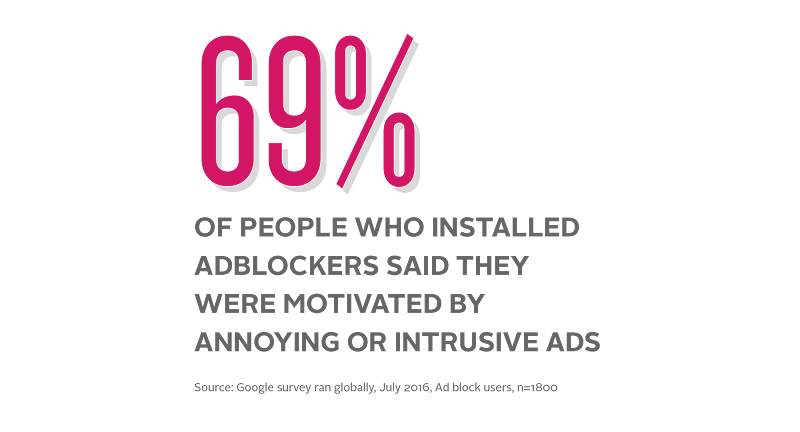
Ads, good and bad, help fund the open web. But 69% of people who installed ad blockers said they were motivated by annoying or intrusive ads. When ads are blocked, publishers don’t make money.

In June we launched the Ad Experience Report to help publishers understand if their site has ads that violate the Coalition’s Better Ads Standards. In just two months, 140,000 publishers worldwide have viewed the report.

“This report is great for helping publishers adapt to the Better Ads Standards. The level of transparency and data is incredibly actionable. It literally says here’s the issue, here’s how to fix it. I think it will be helpful for all publishers.”
Katya Moukhina, ‎Director of Programmatic Operations, POLITICO

We're already starting to see data trends that can give publishers insights into the most common offending ads. Here's a look at what we know so far.

It's official: Popups are the most annoying ads on the web

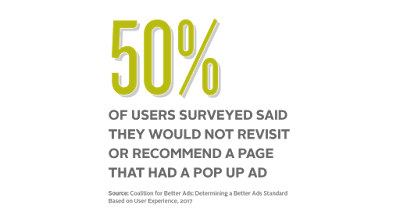
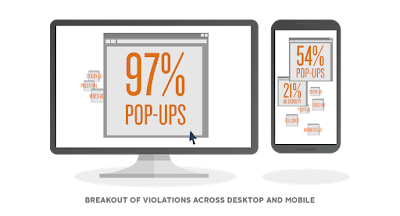
Pop-up ads are the most common annoying ads found on publisher sites. On desktop they account for 97% of the violations! These experiences can be bad for business: 50% of users surveyed say they would not revisit or recommend a page that had a pop-up ad.

Instead of pop-ups, publishers can use less disruptive alternatives like full-screen inline ads. They offer the same amount of screen real estate as pop-ups—without covering up any content. Publishers can find more tips and alternatives in our best practices guide.

Mobile and desktop have different issues

On mobile the issues are more varied. Pop-ups account for 54% of issues found, while 21% of issues are due to high ad density: A mobile page flooded with ads takes longer to load, and this makes it harder for people to find what they're looking for.

Most issues come from smaller sites with fewer resources

Our early reporting shows that most issues are not coming from mainstream publishers, like daily newspapers or business publications. They come from smaller sites, who often don’t have the same access to quality control resources as larger publishers.

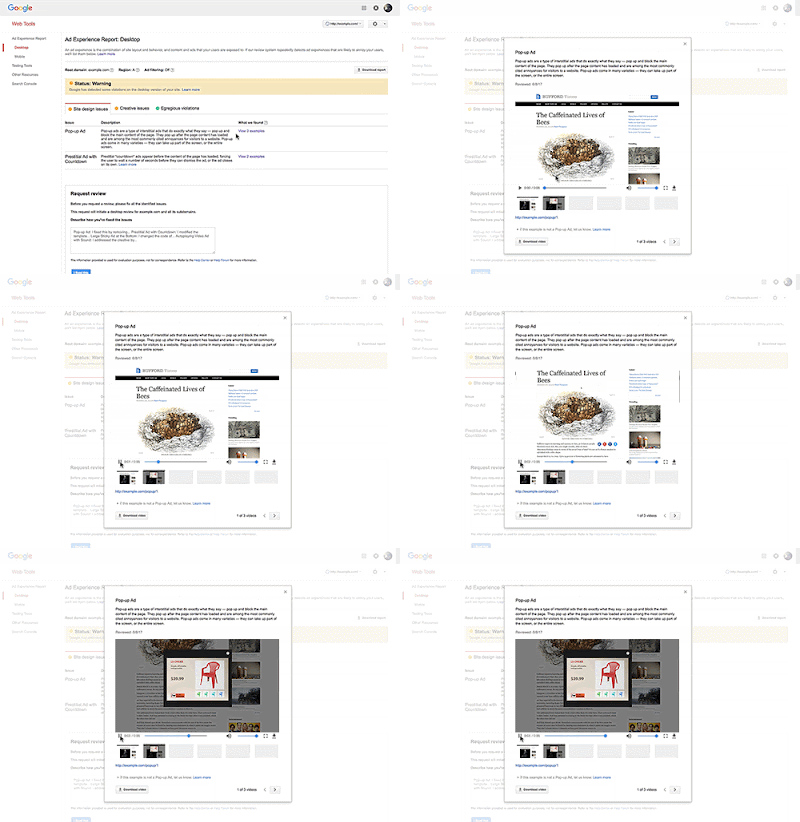
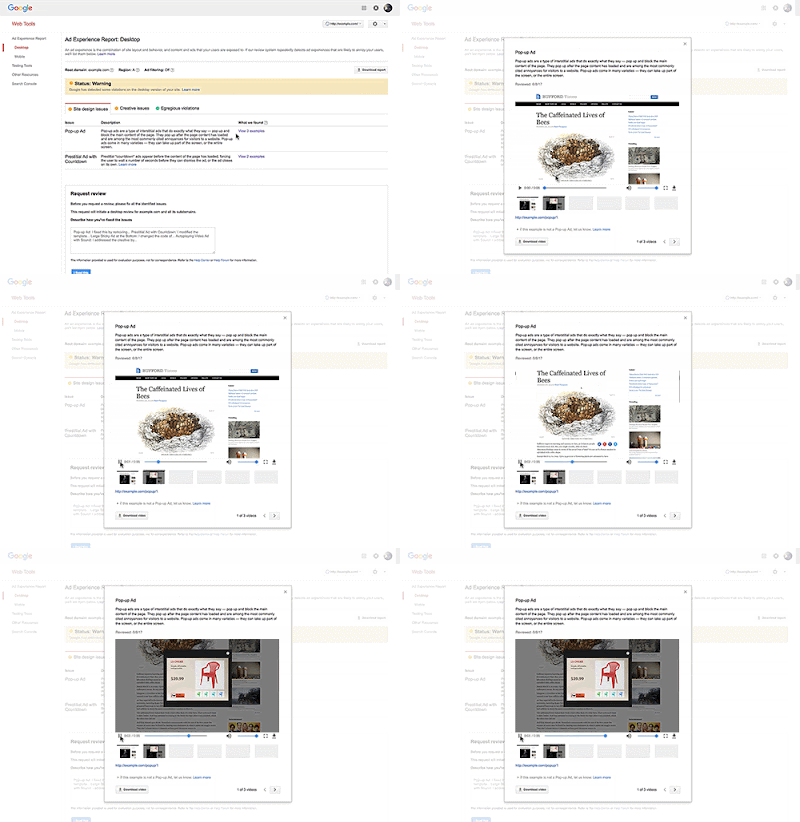
To help these publishers improve their ads experiences, we review sites daily and record videos of the ad experiences that have been found non-compliant with the Better Ads Standards. If a site is in a “failing” or “warning” state, their Ad Experience Report will include these visuals, along with information about the Better Ad Standards and how the issues may impact their site.

We encourage all publishers to take a look at their report. Here’s how.

  1. Gaining access to the report
    The Ad Experience Report is part of Google Search Console, which means you need to be a verified site owner to access it. You can either ask your webmaster to add you as an owner or user, or verify ownership yourself. Learn more.

  2. Understanding the report
    If your site has been reviewed and the status is “Warning" or "Failing," the report will show videos of the ad experiences that are likely to annoy or mislead your visitors. Click on desktop or mobile reports to see the specific experiences identified.


  3. Fixing the issues and requesting a review
    Once you’ve identified the violating experiences, work with your ad ops and site design teams to remove the annoying experiences. After that, describe how you addressed each of the issues in the ‘Request review’ area and click ‘I fixed this’. You’ll receive a confirmation email saying your review is in progress. Learn more.

Looking ahead

Over the next few weeks we’ll begin notifying sites with issues. For even more insights on the types of sites and violations found, publishers can visit The Ad Experience Report API.

The good news is that people don’t hate all ads—just annoying ones. Replacing annoying ads with more acceptable ones will help ensure all content creators, big and small, can continue to sustain their work with online advertising. This is why we support the Coalition’s efforts to develop marketplace guidelines for supporting the Better Ads Standards and will continue working with them on the standards as they evolve.

Scott Spencer
Director of Product Management, Sustainable Ads

Posted:
When we announced the beta of Native Ads on DoubleClick, our goal was to help our partners earn the most money possible with ad experiences that are both engaging and complementary to the user experience. Since then, we’ve seen hundreds of partners deliver beautiful native ads that match the look, feel and function of the surrounding content. And we’ve learned that advertisers are willing to pay more for and users are more likely to engage with native ads compared to traditional ad experiences.

Today we’re happy to announce that all DoubleClick for Publishers (DFP) partners can now deliver native ads programmatically to users across any screen.

Grow your business with native ads

DoubleClick provide a dynamic framework for delivering ad experiences that advertisers and users love. Rather than serving a static image or text ad, native ads deliver an engaging user experience by taking multiple creative components — such as a headline, thumbnail and description — and assembling them in real-time to match the style of the site or app.
Partners like The New York Times are using DoubleClick to deliver premium standalone ad experiences, increasing CTRs 6X. Accuweather is using native ads to grow programmatic yield on their existing ad placements. In fact, this strategy has improved CPMs 40%, with over 15% of their total impressions won by native-specific demand.

“DoubleClick's native product provides the perfect solution for us to increase CPMs while delivering a mobile experience that is consistent with what users expect from Accuweather,” says Bill McGarry, Vice President of Advertising Sales at Accuweather. “Since implementing Native Ads on DoubleClick, we've seen a significant increase in CPMs and we look forward to expanding our investment in native.”

All of DoubleClick, one flexible native solution

With DoubleClick, you can deliver beautiful native ads while leveraging the efficiency and scale of a single platform that works across all of your advertising inventory, sales channels and ad formats — whether they’re custom display, video or native ads.

One of DoubleClick’s strengths is the flexibility it provides in how you connect with advertisers — via Programmatic Guaranteed deals, Private Auctions or manually-trafficked direct deals. With this launch, you can make your native inventory available to advertisers across of your deals, irrespective of how they’re transacted.

We’re also helping you maximize your revenue by allowing these new formats to compete with traditional banner ads. By activating native demand across your existing ad units, you can capture the highest value from a broader group of advertisers competing to serve ads to your audience.

New tools for designing beautiful native ads

Finally, we’ve made it easier for our partners to implement native ads with the launch of 22 new and customizable native styles in DFP. While it's possible to create highly custom integrations from scratch, these templates can serve as a great starting point.

These templates take advantage of the many new features we’ve added this year:

  • Ad attribution and AdChoices badges can now overlap the primary image, removing the need to place these elements in a separate row.
  • Additional style targeting options, like devices and negative key values, help you to show the right style at the right time.
  • Better previews make it easier to see how your native style will look while you build it.

We’ve also developed a guide to building great native ads, with advice from Google’s design team and feedback from advertisers about the type of inventory they want to buy, to help you create beautiful and high-performing native ads.

In a world where high-quality ad experiences are more important than ever, Native Ads on DoubleClick provide a solution for delivering beautiful and impactful ad experiences efficiently while helping you build thriving and sustainable businesses.

To get started with Native Ads on DoubleClick, visit our Help Center or contact your account manager today.

Posted by Aaron Karp
Product Manager, DoubleClick

Posted:
At DoubleClick, we've always had a single mission — to help you grow revenue and build sustainable businesses with advertising. That means ensuring we're helping you make the most revenue from every impression, with solutions that keep up with advertiser demands for more programmatic access to inventory, while at the same time delivering on the expectations of users for great experiences with your sites and apps on every screen. To that end, over the last year we launched products like Optimized Private Auctions, optimized pricing in the Open Auction and DoubleClick for Publishers First Look.

Today, we’d like share some updates on how we’re using the power of automation and machine learning to create sustainable solutions that drive greater advertising performance and revenue for our partners.

Smarter yield through machine learning

Programmatic buying has created many opportunities for publishers to maximize revenue, but optimizing manually puts publishers at a disadvantage when programmatic buyers are constantly investing in smarter bidding technology. That’s why we’ve been applying optimization and machine learning techniques developed over the years at Google to help publishers make more money from programmatic demand. In fact, since 2016 we have run hundreds of experiments resulting in over 50 improvements to our auction algorithms. These optimizations have generated 15% more revenue for publishers using DoubleClick Ad Exchange.

Actionable insights with Opportunities & Experiments

Data can be an important input for making better decisions, but the best yield management strategies also include constant testing and measurement. To make this process easier, we recently launched a new Opportunites & Experiments tool that puts publishers in control of Google intelligence.

Publisher opportunities and experiments in DoubleClick for Publishers and DoubleClick Ad Exchange provide customized, actionable and quantifiable suggestions on how to increase yield. With a few clicks, publishers can safely run an experiment, and if they like the results, accept the change to apply it across their account. Publishers including The Soul Publishing in Russia, TV2 in Norway, and Match.com in the U.S. have grown revenue with Opportunities and Experiments.

"Opportunities and experiments lets us bypass the heavy, manual labor part of the yield optimization process. It lets us skip straight to projecting results of possible changes and testing a yield hypothesis against a control test group in a safe way. Essentially, the feature helps us find the test cases worth our time automatically, letting us focus on increasing yield and revenue,” says Mikaela Rimaila, Programmatic Manager, TV2. "Personally I’d love to do all my yield optimization through this feature, as it adds a safety layer to rule changes, easily giving us the chance to compare and analyse the effects of the test.”

"Opportunities and experiments in AdX has helped streamline our yield optimization process and boosted our indirect revenue. We receive customized suggestions to increase our yield, such as floor adjustments, and have seen significant gains as a result."
- Gregg Murphy Senior Director, Revenue Operations, Match.com

Bringing Exchange Bidding to more partners demand without compromising user experience

We’ve made a lot of progress since announcing our test of Exchange Bidding last year, and today we’re happy to announce the Open Beta of Exchange Bidding, available for publishers using DoubleClick for Publishers* globally. Exchange Bidding helps publishers bring more of their programmatic demand together into a unified auction and the results have been impressive. On average Exchange Bidding is delivering double-digit programmatic revenue uplift, with some publishers seeing programmatic lift as high as 40% with minimal impact to user experience. Today, 100+ publishers can choose from 7 trusted third party exchanges, including our new partners, COMET, OpenX and Sovrn.

"We've been working with Google on the development of Exchange Bidding for several months now and while it's still early, we are pleased with the level of partnership and transparency we have seen from the Google team. While there are still issues to be resolved and the product is very complex, their efforts have resulted in real and positive changes to the Exchange Bidding product. Based on our experience so far, and the excellent results we have seen to date, we are optimistic that we can deliver material value to our publisher partners via Exchange Bidding."
- Jason Fairchild, Co-Founder and Chief Revenue Officer, OpenX

Driving sustainability in the future

Looking back at the results from our latest yield management improvements shows us what’s possible, but I think we can do more. We’ve shown how machine learning can deliver more value to publishers, and in the future, we’ll continue to invest in it to deliver even more innovations. Also, the work our teams have been doing on server side technologies have revealed more opportunities to improve publisher revenue by taking advantage of synergies across our products. Publishers using DoubleClick for Publishers and DoubleClick Ad Exchange may have noticed our first step in this direction, a unified UI for both platforms. Moving forward you should expect more innovations like these to increase publisher yield.

Posted by Jonathan Bellack
Director of Product Management, Publisher Platforms
*Exchange Bidding is not currently available to publishers using DoubleClick for Publishers Small Business

Posted:
When we announced the pilot program for Exchange Bidding last year, our goal was to help publishers earn the most money possible, with the least complexity, while maintaining the best user experience.

We’ve been working on Exchange Bidding in collaboration with our publisher and exchange partners for the last year, and today we’re happy to announce the Open Beta of Exchange Bidding, available to publishers using DoubleClick for Publishers* globally. Our partners have been seeing great results during our testing, and we’d like to give you more details about this powerful enhancement to DoubleClick for Publishers.

Greater revenue without compromising user experience

When every millisecond counts, the fastest solutions yield the best results. Relying on client side connections over mobile networks to manage yield can result in annoyed users, lower viewability and lost opportunities.

That’s why we challenged ourselves and worked hard to prioritize speed during the closed Beta. To maximize revenue without compromising on user experience, we built Exchange Bidding directly into DoubleClick for Publishers.

The results speak for themselves. Publishers in our closed beta have seen double-digit programmatic revenue lift on average, with some seeing programmatic lift as high as 40%. Plus, Exchange Bidding is up to 15x faster than client side or server side solutions in the market today. While header bidding solutions add on average 500ms to 1,000ms of delay to ad delivery speed, Exchange Bidding adds only 60ms seconds of delay.

Publishers like Hearst Digital are seeing great results.

“Our goal is to move as much of our advertising code off our sites as possible. Less code loading on the client side is better. Exchange Bidding is great because it helps us move in that direction. It’s simple to setup and works with our existing DoubleClick tags.”
- Scott Both, Director of Programmatic Sales Engineering, Hearst Digital Media

Reduced complexity with all demand in one ad tag

Beyond speed and revenue lift, Exchange Bidding creates greater value for publishers by reducing the complexity of their existing yield management setups. Because Exchange Bidding is built into DoubleClick for Publishers, it works with our existing ad tags, requires no additional coding to a publisher’s site or app or additional line items cluttering up a publisher’s ad server, and puts no additional burden on users.

Instead of taking days or weeks of development and adjustments to set up, publishers can get Exchange Bidding up and running in less than a day. Instead of constantly updating the price and priority of partner line items or adding hundreds or thousands of new line items to implement header bidding, publishers simply create a handful of yield groups that define which third party exchanges can bid on specific inventory. And instead of spending days collecting reporting and billing information from multiple partners, reconciling discrepancies, and waiting to get paid, Exchange Bidding provides publishers unified reporting and consolidated billing on our standard terms.

“Integrating and maintaining client side headers is a significant investment for any publisher. Setting up server side bidding with Exchange Bidding was simple. It also helped us reduce a lot of the operational overheads associated with headers and it promises to reduce latencies and discrepancies whilst improving scalability”.
- Nat Poulter, Head of Programmatic at MailOnline

We only succeed when our partners succeed

We understand that in order to help publishers thrive we must foster a sustainable advertising ecosystem. That means creating solutions that deliver the most revenue possible for publishers, while maintaining great experiences for users, and providing all players in the industry equal access to high quality inventory.

To ensure we were getting the right feedback from all parties, we created an advisory board with members from our initial exchange partners. It’s feedback from this group that helped inform the development of Exchange Bidding and make it work better for every participant.

"We've been working with Google on the development of Exchange Bidding for several months now and while it's still early, we are pleased with the level of partnership and transparency we have seen from the Google team. While there are still issues to be resolved and the product is very complex, their efforts have resulted in real and positive changes to the Exchange Bidding product. Based on our experience so far, and the excellent results we have seen to date, we are optimistic that we can deliver material value to our publisher partners via Exchange Bidding."
- Jason Fairchild, Co-Founder and Chief Revenue Officer, OpenX

We’ve seen great results during the testing phase of Exchange Bidding. Today, 100+ publishers can choose from seven trusted third party exchanges including our new partners, COMET, OpenX and Sovrn to compete equally in a unified auction against a publisher’s direct sold campaigns in DoubleClick for Publishers and bids from DoubleClick Ad Exchange. We look forward to working with our existing and new users to make Exchange Bidding the best solution for the industry.

Posted by Sam Cox
Group Product Manager, DoubleClick Ad Exchange

*Exchange Bidding is not currently available to publishers using DoubleClick for Publishers Small Business

Posted:
Cross-posted from The Keyword

The vast majority of online content creators fund their work with advertising. That means they want the ads that run on their sites to be compelling, useful and engaging--ones that people actually want to see and interact with. But the reality is, it’s far too common that people encounter annoying, intrusive ads on the web--like the kind that blare music unexpectedly, or force you to wait 10 seconds before you can see the content on the page. These frustrating experiences can lead some people to block all ads--taking a big toll on the content creators, journalists, web developers and videographers who depend on ads to fund their content creation.

We believe online ads should be better. That’s why we joined the Coalition for Better Ads, an industry group dedicated to improving online ads. The group’s recently announced Better Ads Standards provide clear, public, data-driven guidance for how the industry can improve ads for consumers, and today I’d like to share how we plan to support it.

New tools for publishers

The new Ad Experience Report helps publishers understand how the Better Ads Standards apply to their own websites. It provides screenshots and videos of annoying ad experiences we’ve identified to make it easy to find and fix the issues. For a full list of ads to use instead, publishers can visit our new best practices guide.


The Ad Experience Report lists when we have identified ad experiences on a site that are likely to harm users or violate the Better Ads Standards.

“We’ve always put our users first and fully support the Coalition’s Better Ads efforts and standards. At the same time, we deal with so many different websites and ad experiences it’s hard to tell at a glance which ads experiences we need to replace. The report’s videos and screenshots are incredibly helpful and make the Coalition’s research actionable for our teams. We’re impressed with the level of detail and transparency Google is providing and are 200% behind this initiative.”
- Troy Young, President, Hearst Digital Media

As part of our efforts to maintain a sustainable web for everyone, we want to help publishers with good ad experiences get paid for their work. With Funding Choices, now in beta, publishers can show a customized message to visitors using an ad blocker, inviting them to either enable ads on their site, or pay for a pass that removes all ads on that site through the new Google Contributor.

“Looking at the past few years, we’ve come to realize that to the rise of ad blockers has negatively impacted potential revenue across all of our properties, particularly in Europe. Funding Choices allows us to have a conversation with visitors using ad blockers on how our business works, and provide them a choice to whitelist or contribute to our newsroom. We’ve found that people are generally open to whitelisting once they understand how content gets created.”
- Marc Boswell, SVP, Sales Operations & Client Services, Business Insider

Funding Choices is available to publishers in North America, U.K., Germany, Australia and New Zealand and will be rolling out in other countries later this year. Publishers should visit our new best practices guide for tips on crafting the right message for their audience.

Chrome support for the Better Ads Standards

Chrome has always focused on giving you the best possible experience browsing the web. For example, it prevents pop-ups in new tabs based on the fact that they are annoying. In dialogue with the Coalition and other industry groups, we plan to have Chrome stop showing ads (including those owned or served by Google) on websites that are not compliant with the Better Ads Standards starting in early 2018.

Looking ahead

We believe these changes will ensure all content creators, big and small, can continue to have a sustainable way to fund their work with online advertising.

We look forward to working with the Coalition as they develop marketplace guidelines for supporting the Better Ads Standards, and are committed to working closely with the entire industry—including groups like the IAB, IAB Europe, the DCN, the WFA, the ANA and the 4A’s, advertisers, agencies and publishers—to roll out these changes in a way that makes sense for users and the broader ads ecosystem.

Posted by Sridhar Ramaswamy
Senior Vice President, Ads and Commerce