We've moved! Please subscribe to the Google Ad Manager blog for updates


Posted:

Advance Auto Parts (AAP) is a leading retailer of automotive parts, accessories, batteries and maintenance items with over 3,900 physical stores as well as a thriving e-commerce business.

In late 2012 AAP began testing DoubleClick Ad Exchange (AdX) in order to offer ad placements on its e-commerce site. The aim was to derive additional revenue from non-converting traffic, and AdX proved a perfect fit:

More revenue, more conversions
AAP’s goal was to gain incremental revenue from the ads, but they were worried that existing conversion rates might be negatively affected. Fortunately, these fears were quickly overcome, as implementing ad units on the site in fact saw conversions increase.

Great tools equal happy customers
AAP was concerned about preserving brand safety as well a positive site experience for its users. Thanks to the robust set of tools and controls provided in AdX, AAP was able ensure ads from major competitors didn’t appear and that bounce rates remained unaffected.

E-commerce and ads: an ideal balance
“Working with AdX has taught us that online ads and e-commerce can certainly work together gracefully,” says Howard Blumenthal, AAP’s director of eBusiness platform solutions. “If you can get this balance right, you end up with the ideal situation.”

So what’s next? Howard reveals AAP has plans in place to use AdX to monetize the company’s mobile site, too. “We are always looking for ways to increase incremental revenue by optimizing AdX as much as possible.”

Read the full Advance Auto Parts story >>

Posted by Ian Cohan-Shapiro, Product Marketing Team
Posted:
A top name in weight loss and healthy living for 50 years, Weight Watchers serves over 140 million ad impressions a month at WeightWatchers.com.

Weight Watchers began using the Google Publisher Tag (GPT) in 2012 once they upgraded to the DoubleClick for Publishers (DFP) ad server. They were hoping for better targeting, but they got much more.

Higher ROI, happier advertisers
With up to five levels of targeting hierarchy, GPT let Weight Watchers improve its targeting and end manual re-tagging. The results have been strong with Click Through Rates across all standard display ad units are up 13%, and for leaderboards up 76%. Advertisers are loving the performance and Weight Watchers now runs four times more monthly campaigns with advanced targeting than with basic demographic and geo-targeting.

100% boost in operational efficiency from DFP

"I would actually say we've had a 100% increase in efficiency," says Jordan Tuck of Weight Watchers. Campaign setup is faster, and new features like the ability to update multiple line items on the same page save even more time later.

30% rise in indirect inventory earnings

With the move to DFP, Weight Watchers benefited from Dynamic Allocation with DoubleClick Ad Exchange (AdX) to monetize indirect inventory. Their indirect inventory rates are up 30% year-over-year, and the clickthrough rate is 2.5 times higher than it was before AdX. AdX now has 70% share of their indirectly sold inventory.

Weight Watchers helps its customers "move the needle," and DFP and AdX have helped them do the same with their own online properties.

Read the full Weight Watchers story »

Posted by Yamini Gupta, Product Marketing Team

Posted:
It was a great year for digital advertising. New technologies took off, helping brands, agencies and publishers reach today’s constantly connected consumers more easily and effectively than ever before. With budgets no longer being siloed, 20% of organizations incorporated digital into each marketing function, per a study by Adobe.

We compiled a few of the bigger changes in marketing and digital advertising in 2013, to see how far the industry has come along. View the full infographic here or see a brief summary below.

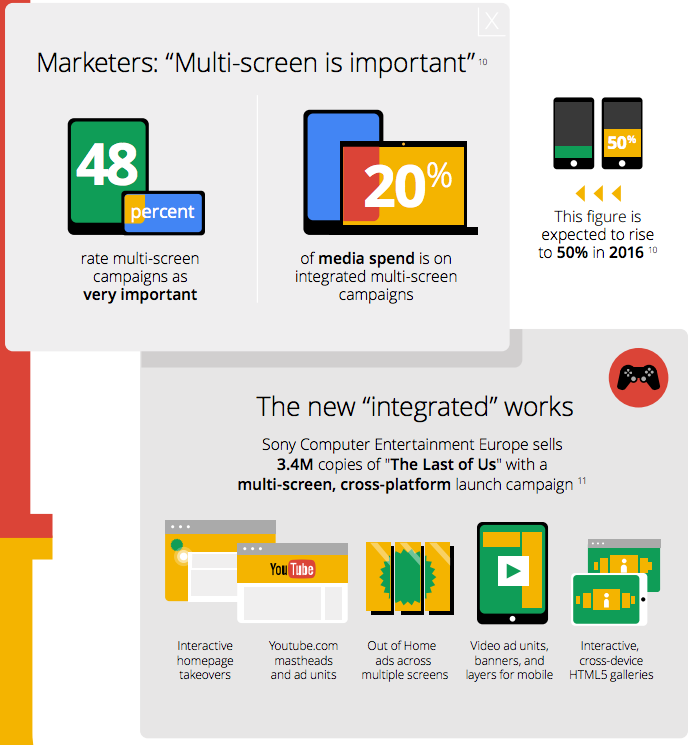
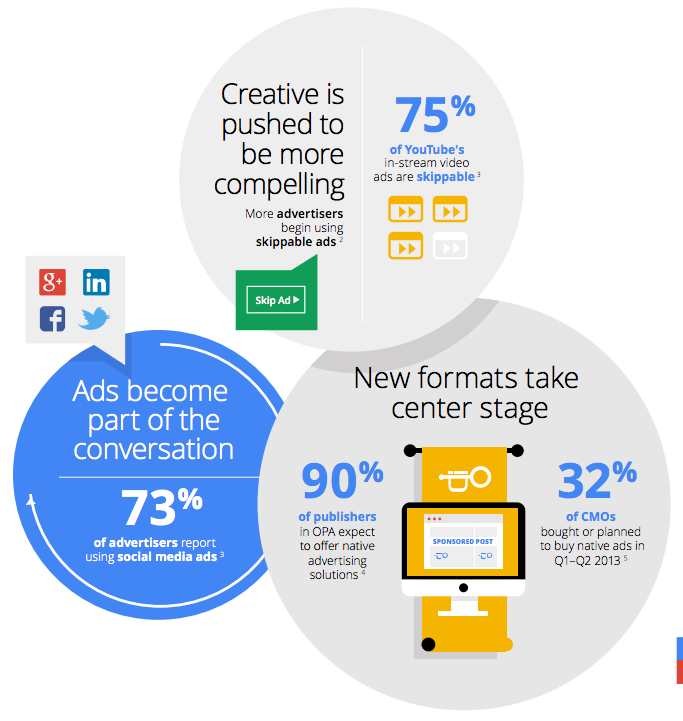
Redefining “creative”
New creative formats took center stage in 2013. Marketers invested more in social media and TrueView skippable video ad formats continued to grow on the DoubleClick Ad Exchange.


Redefining “integrated”
The new 360 media plan cannot overlook digital and the sheer number of screens people interact with. In 2012, Google released some research indicating that people use 3 screen combinations a day. In 2013, this manifested itself in the form of increased investments in multi-screen campaigns.


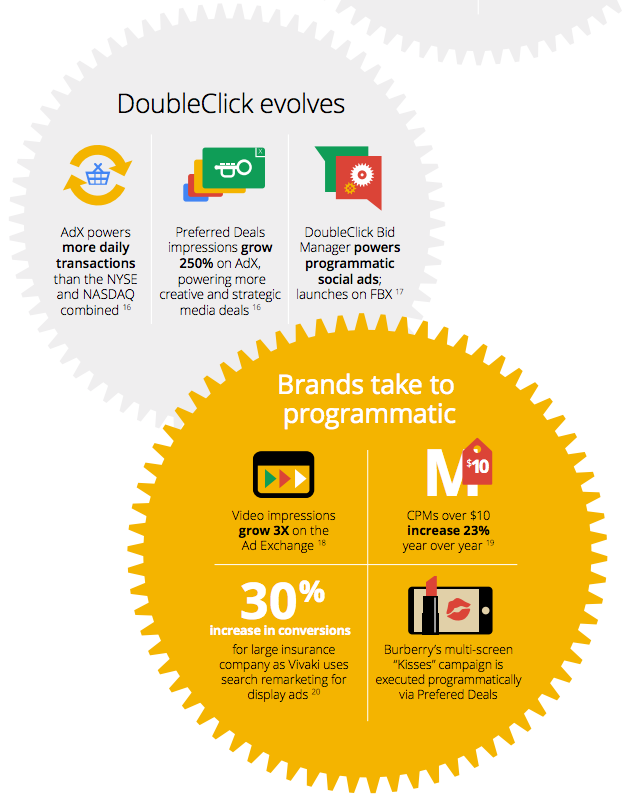
Redefining “buying”
New(Up)fronts. Programmatic. 2013 changed the way digital media spend is committed.18 digital media companies presented at the Digital Content NewFronts. And programmatic buying gained significant traction with an expected ~74% growth, according to eMarketer. As brands took to programmatic and with the growth of programmatic video, CPMs on the DoubleClick Ad Exchange increased, and Preferred Deal impressions grew 250%. DoubleClick Bid Manager powered social media ads, joined FBX.


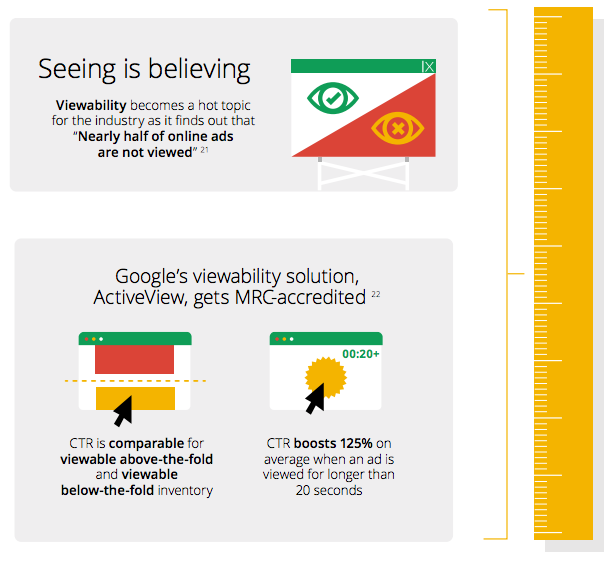
Redefining “success”
Earlier this year, AdAge released some research indicating that 50% of display ads are not viewed, making advertising viewability a hot industry topic. Google’s viewability measurement solution, ActiveView, got MRC-accredited. Last week, Google announced that it would enable viewability-based buys on the Google Display Network. Engagement Rate was another hot metric in 2013, with Cost per Engagement pay models enabled for ad formats like Engagement Ads on the Google Display Network.


View the full infographic here.

Posted by Yamini Gupta, Product Marketing Team

Posted:
By now, it’s evident that multi-screen consumption is the way of the future; mobile and tablet devices are becoming consumers’ first screens, so the content that is developed needs to work seamlessly across these screens. There are already more end-users in HTML5-compatible environments than there are in Flash-compatible environments, and HTML5 ad spend is expected to overtake Flash spend within the next two years (1). But until recently, advertisers and publishers didn't have the tools they needed to easily develop content fit for today's cross-screen experiences.

Build once, run anywhere 
We’re working hard to solve this development challenge by offering powerful yet easy-to-use tools for HTML5 production. In this vein, we announced DoubleClick Studio Layouts for HTML5 back in August (also available to DFP Premium publishers using DoubleClick Studio), which lets you create HTML5 ads in minutes, and last week we announced Ready Creatives in AdWords, which creates HTML5 ads for you in seconds.


Today, we’re excited to announce the public beta of Google Web Designer, a new professional-quality design tool that makes HTML5 creative accessible to everyone from the designer to the dabbler.

Google Web Designer enables you to:
  1. Create animated HTML5 creative, with a robust, yet intuitive set of design tools. 
  2. View and edit the code behind your designs and see your edits reflected back on the stage automatically. 
  3. Build ad creatives seamlessly for DoubleClick and AdMob, or publish them to any generic environment you choose. 
  4. Receive updates to the product automatically, without having to re-download the application.
  5. Access all of this entirely for free.

Watch the Demo: A quick glimpse of Google Web Designer

Ready to give it a spin? 
  • Download Google Web Designer. 
  • Read through our getting started guide
  • Send us feedback! We need your input to make this tool even better, so share your ideas with us in our user forum or on our Google+ page. We’re working hard over the next couple quarters to add new features and improvements to make the product an even more robust offering. 
HTML5 is a universal language for building beautiful, engaging content that can run across desktops, smartphones, and tablets. We think that Google Web Designer will be the key to making HTML5 accessible to people throughout the industry, getting us closer to the goal of “build once, run anywhere.”

NOTE: Publishers using DFP or DFP Small business, see our Help Center articles to learn more about trafficking creatives. DFP Help CenterDFP Small Business Help Center.


Posted by Sean Kranzberg, Lead Engineer, Google Web Designer 

(1) StatCounter, Top 12 Browser Versions in North America, February 2012 to August 2013 

Posted:
A few months ago, we kicked off the Video in the Future content series featuring speakers like AOL’s Ran Harnevo, Meredith’s Liz Schimel, NewsCorp’s Rahul Chopra and AMC’s Kirk Linden, among others.

The next edition in this series will be from Australia, as we’ll speak with Adam Good, Director of Digital Media & Content, at Telstra.

From Telstra’s long history as a telco to now, a media empire - how is the company creating, promoting and monetizing digital video content to engage its audience? Adam will speak about Telstra’s digital video strategy in a conversation with Jason Pellegrino, Sales Director for Google Australia and New Zealand.

Join us live on September 24, 10:30AM Sydney time. RSVP here.