We've moved! Please subscribe to the Google Ad Manager blog for updates


Posted:

Users read, watch, listen, and connect with content across multiple screens throughout the day. With every interaction, they expect fast, safe, and relevant experiences regardless of where they are or what device they’re using. In this environment, publishers only have a split second to deliver the most relevant and highest paying ads to maximize their overall yield without increasing latency and potentially losing users.

A few weeks ago at the IAB Ad Operations Summit, I spoke about a new feature we are testing to deliver yield, speed, and control, called DoubleClick for Publishers First Look. Today, I’d like to give you some more details about it.

One of the fastest-growing segments of programmatic advertising has been from high-CPM, low-match-rate buyers, such as remarketers. These buyers are willing to pay a substantial premium to publishers in exchange for a ‘first look’ at all of a publisher’s inventory, but they need to see a lot of impressions to find the ones they value. The standard implementation of this first look has been through a header bidding tag to indicate interest. While this works, unfortunately it has drawbacks. It adds latency to every pageview, gives one buyer preferential access, and gives up the control and protection of an ad exchange. A better solution would reduce or eliminate latency, enable any selected buyer to compete, and allow publishers to manage demand just as they do with other private or open marketplaces.

First Look does just that. It allows publishers to give trusted programmatic buyers the opportunity to bid on 100% of their inventory -- even ahead of sponsorships and reservations. By allowing these buyers to see more inventory, and by putting them in real-time competition with each other, publishers in our Beta test have seen an average 10% lift in revenue. First Look is simple to set up (no added line items), creates zero added latency (no additional ad requests), and works across all channels and formats. And since First Look is part of the DoubleClick Ad Exchange, you don’t lose any of the controls and protections you already rely on like creative review, category blocking, or malware protection.

“First Look has shown strong performance, increasing our revenue by a double digit percentage across all of our properties. There were no added tags and no need to change our page setup. Best of all, there has been no impact to what our users experience when they visit our properties, regardless of the device they’re using."
Jeremy Hlavacek, Vice President, Programmatic, The Weather Company.

We believe that First Look is good for buyers, too. According to Sam Cox, Vice President at MediaMath:

“First Look is an exciting step towards having all demand compete, simultaneously. Access to more users who are typically consumed by guarantees will drive higher ROI, and the high prices of the inventory should dispel any myth that programmatic is not premium."
Sam Cox, Vice President, OPEN Global Media Management, MediaMath

As I mentioned at the IAB Ad Ops Summit, DoubleClick’s mission is to help our publisher partners grow their ad revenues in a healthy long-term market. With First Look we are striving to create a solution that delivers lift for publishers without sacrificing consumer experience or publisher controls.

We’re excited to launch DoubleClick for Publishers First Look to all publishers early in 2016. Space in our beta is limited, but if you’re interested in getting set-up before the holiday rush, contact your account manager today. And in the coming weeks, stay tuned for more tips on how to maximize your overall yield.

Posted by Jonathan Bellack
Director, Product Management

Posted:

During the 37 hours per month typically spent in apps, people look to their mobile devices for information and entertainment.

This comes as no surprise, however, to our DoubleClick customers. You already see most of your audience is mobile: more than half the queries on our platform today come from mobile devices, across mobile web and apps. This holiday season will bring increased traffic and even greater potential to grow revenue, peaking in January. Mobile app installs are expected to increase by 150% on Christmas Day compared to an average day in December.

To help you take advantage of the surge in user activity on mobile, and particularly in apps, we’ve gathered our most actionable research and best practices. Make the most of the holiday app frenzy with this four-day mobile bootcamp on reaching, engaging, and monetizing your app audiences.

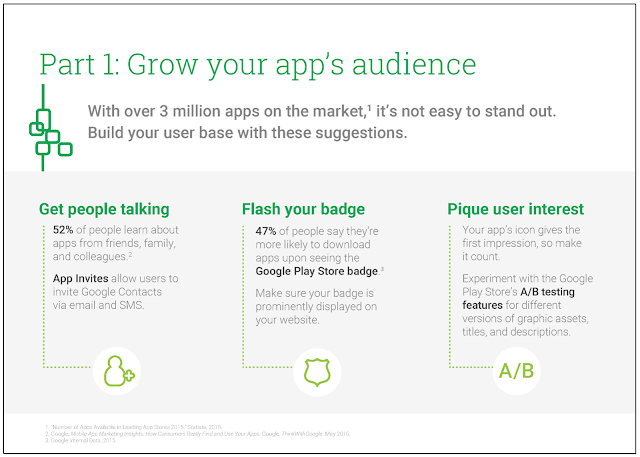
Grow your app’s audience

Of the five hours per day that US consumers spend on smartphones, 54% of digital media time is spent in apps. How can you ensure your app is one of those? Cheney Tsai, our Mobile Solutions Consultant at Google, recommends five steps to help you connect with your audience everywhere.

  1. Get people talking about your app: 52% of users learn about an app from friends, family, or colleagues, proving yet again word-of-mouth is a reliable promotion method. Cheney suggests using App Invites, a beta feature for iOS and Android, which allows users to invite Google contacts to your app via email and SMS. As explained by Cheney, "First impressions matter! App Invites allow you to reach new users with a warm welcome, which could be game-changing for the long term value of your user. You can even reward the sender/receiver with a custom deal just for them."

  2. Make it easy for your existing users to find you, everywhere: By expanding your house ad campaigns to cross-promote on existing properties, you can target desktop users in addition to those on Android and iOS. Use App Indexing to redirect your SEO based traffic to your app; users who have the app are redirected into it while those without the app are prompted to install. Also, make sure your Google Play Store badge is prominently displayed on your website. Users are 47% more likely to trust and download apps upon seeing the Google Play badge!

  3. Optimize your creatives to pique users’ interests in stores: Your app’s presentation in app stores directly impacts downloads. Since the icon is the first impression, make it polished and descriptive with a featured image demonstrative of your app’s uniqueness. Experiment with the Play Store’s A/B testing features for different versions of graphic assets, titles, and descriptions. Cheney recommends playing up keywords with which users are most likely to find your app!

  4. Identify high performing channels and optimize with better analytics: Pinpoint your most successful app install campaigns and creatives to create an effective promotion strategy. For both iOS and Android, you can use Google Analytics to understand your user drop off points. Dive even deeper with app install tracking and custom campaigns to identify your top app referrers!

  5. Listen to your users and address their concerns: User comments may offer constructive feedback, so it’s integral to have a plan in place to respond and make changes. In Google Play Developer Console, you can reply to reviews to help users overcome a problem or communicate relevant information. According to developers like James Jerlecki at Text Plus, “The Reply to Reviews feature has essentially given me that direct line [to users] that I didn’t have before.”Just remember your reply is publicly visible, so ensure you have the right person in your organization replying.

With over 3.1 million apps across the Google Play and Apple stores, your app needs to be present whenever users are looking to discover new apps and stand out from the crowd when they find your app. Check out this blog tomorrow for recommendations from Jason Rosenblum, Mobile Solutions Consultant at Google, for engaging your users.

Posted by Danielle Landress
Associate Product Marketing Manager, Publisher Marketing

Posted:

Mobile is changing the way people experience content - including advertising. Every time they reach for their devices, they expect to find what they are looking for and be engaged, and they quickly look elsewhere if their experience is poor. In this environment, publishers must take new approaches to advertising to grow revenue. More than ever before, advertising experiences need to be relevant and respectful of the user’s context in the moment.

At DoubleClick, we’ve been investing heavily to help publishers address this challenge. With DoubleClick Ad Exchange, we’ve built programmatic technologies that scale advertising to wherever users are, in the moments that they’re most likely to respond. We’ve also developed mobile-first, immersive ad formats to keep users engaged and ensure advertiser goals are met. Today we’re excited to bring these two areas of investment together for our DoubleClick customers with programmatic support for native and video formats on mobile.

Enabling publishers to sell native ads programmatically

Earlier this year, we announced support for native formats in DoubleClick for Publishers. Now we’re also enabling publishers to sell native ads programmatically, both in the open auction and in private marketplaces, on DoubleClick Ad Exchange. This is available now in apps and will roll out for cross-screen native ads over the next few months. Beta testers of these features, including eBay, have already experienced strong results.

As a pioneer in the programmatic space, eBay recently rolled out its Native Mobile Programmatic solutions, which have revolutionized the way brands deliver their message to the right person, at the right time. Since the launch of its new native ad unit, eBay is seeing a 3.6x increase in ad engagement on average, with some campaigns delivering click-through rates up to 5%.

“We’re focused on leveraging DoubleClick’s technical footprint to bring scalability to our native mobile programmatic offering,” says Brian Brownie, Director of U.S. Display Operations & Programmatic Advertising at eBay. “Our success with desktop private marketplaces, backed by eBay insights, has unlocked massive client adoption and this next phase of mobile delivery is a continuation of the effort.”

"The eBay Native in-app offering has a very powerful combination of attributes — high quality inventory, programmatic access and a cross-channel audience at a scale few can match,” says Michael Collins, CEO of Adelphic, a leading mobile and cross-channel DSP. “These attributes combine to give brands a unique and high-impact opportunity for their advertising investment, especially in the upcoming holiday season.”

Introducing programmatic support for mobile video interstitials in apps

Along with native ads, we’re also introducing programmatic support for mobile video interstitials in apps on DoubleClick Ad Exchange. Video is key to driving brand impact in the moments that matter, no matter where they occur. With these new immersive, full-screen video ads available programmatically, again in both the open auction and in private marketplaces, publishers can offer their advertising partners a new way to bring engaging brand experiences to users seamlessly, driving advertiser performance and growing publisher revenue. During beta tests, publishers realized gains as high as 30% CPM in interstitial video compared to regular interstitial performance.*

Together, these innovations help address a strong demand from ad buyers for native and mobile video formats that can be bought programmatically.

"We've been a longtime supporter of DoubleClick’s programmatic solutions for mobile,” says Adam Foroughi, CEO and Co-Founder of AppLovin Corporation. "The Native and Mobile App Video ads on AdX are in high demand among our buyers and have shown strong performance both for advertisers and publishers. We're happy launch partners with DoubleClick on these new initiatives."

As the digital world around us continues to shift, these innovations are just some of the ways we’re helping publishers and advertisers adapt to changing consumer preferences and thrive.

Posted by Jonathan Bellack
Director, Product Management
Source: eBay Ad Serving Reports, in-app home screen placements, FY 2015.
*There are many factors that impact video demand on a publisher's app and experiences may vary.

Posted:

When advertisers pay for an ad, the chance for it to be seen is a basic expectation. Advertisers shouldn’t have to pay extra to measure and ensure that it was viewable. These expectations drove the launch of Active View back in 2013, an effort to establish a neutral and common set of viewability metrics used by both advertisers and publishers. Since then we've continued to invest in this technology across DoubleClick, YouTube and the Google Display Network, and today we're happy to share two new updates that will help advertisers and publishers run more effective cross-screen campaigns.

Announcing Active View optimization in DoubleClick Bid Manager - A better way to programmatically buy viewable impressions

Today, we're introducing Active View bid optimization in DoubleClick Bid Manager for clients globally. This new bid optimization feature uses the collective intelligence from many signals (e.g. URL, time of day, page category) to predict, impression by impression, the probability that it will be viewable. It then dynamically adjusts bids higher or lower based on that probability to deliver the viewable CPM target that advertisers set for their video and display campaigns. Active View optimization delivers what advertisers actually care about - the total volume of viewable impressions - and doesn’t fixate on a viewable percentage.

This will help solve a common problem: when marketers buy viewable impressions programmatically using current viewability targeting, the decision to bid on a single impression is very basic. Buyers choose a target viewable percentage (e.g. 50%) and their programmatic buying system bids the same amount for any impressions with a likelihood of being viewed above that target - or nothing at all for impressions with a likelihood of being viewed below that target. This means that buyers are missing out on wide swaths of inventory that may actually be viewable and are driving up competition (and CPMs) for the inventory they are buying.

Announcing Active View for mobile apps in DoubleClick for Publishers and DoubleClick Ad Exchange - Bringing holistic viewability measurement to publishers

We believe that viewability metrics should be a standard currency between buyers and sellers. To enable this, we've been investing in features that allow publishers to see and report on a holistic picture of viewability across their channels and content. We're continuing that momentum today by announcing Active View reporting for mobile apps in DoubleClick for Publishers and on the DoubleClick Ad Exchange. With the consumer shift to mobile reshaping how publishers engage with their audience and those interactions increasingly happening on mobile apps, this new measurement solution completes the picture for publishers helping them see how viewability plays out across all of their properties.

At Google, we remain committed to investing in a broad set of measurement solutions for brands and publishers through a combination of product innovation with our own solutions and partnerships with leading third parties. These announcements are two big steps in our ongoing effort to help our clients measure every moment that matters.

Posted by:

Ari Feldman
Product Manager, DoubleClick for Publishers Reporting and Active View
Deepti Bhatnagar
Product Manager, DoubleClick Bid Manager Brand Measurement and Optimization

Posted:

Last week, the Trustworthy Accountability Group (TAG) announced the “Verified by TAG” initiative to help increase transparency of digital advertising transactions across the industry. We’re fully supportive of both programs outlined in TAG’s announcement and we’re currently in the process of applying for TAG Registration. To support the adoption of Payment IDs across the ecosystem, starting today our version of Payment IDs is available in DoubleClick Ad Exchange to all buyers globally.

Currently, if a programmatic buyer finds they’ve bought fraudulent inventory, there is no way to directly identify the supply source responsible for the fraud. The Payment ID system we proposed to the TAG Anti-Fraud working group fixes this problem by asking all supply sources (e.g. ad exchanges, ad networks, supply side platforms) of advertising inventory to create and provide unique and persistent anonymous identifiers that link every impression to who is paid in their accounting systems. If a buyer finds invalid activity from any source in their supply chain, these Payment IDs will help the buyer to identify who is responsible and blacklist those suppliers from their campaigns.

We’ve always invested heavily to keep DoubleClick Ad Exchange free of invalid activity and ensure that money spent on our platform only goes to support legitimate publishers, app developers, and content creators. To show our commitment to a better ads ecosystem, accelerate the adoption of Payment IDs, and help DSPs start integrating them, we’ve implemented the standard as it exists today, and we’ll continue to work closely with TAG and others in the industry to formalize an industry-wide Payment ID program. When the TAG Anti-Fraud Working Group has finalized the broader industry standard, we’ll happily make any changes to ensure we are compliant with TAG’s efforts.

"Google has been at the forefront of the fight against digital ad fraud, and this announcement advances our work together to develop an industry-wide Payment ID system. We look forward to continued collaboration with Google and other programmatic leaders through the TAG Anti-Fraud Working Group to create a fully transparent digital ad supply chain that will expose the bad actors and cut off their financial support."
Mike Zaneis, CEO, TAG

Leading programmatic buyers, DoubleClick Bid Manager, Dstillery, Magnetic, MediaMath, Rocket Fuel, The Trade Desk, and Turn have all committed to integrating Payment IDs into their systems in the coming months.

Posted by:

Vegard Johnsen
Product Manager, Google Ads Traffic Quality
Chetna Bindra
Product Manager, DoubleClick Ad Exchange